Insights
Company news, exhibitions and practical notes on running and maintaining material handlers.
Deliveries, product launches and exhibitions from Henan Huanghai Heavy Equipment.
Practical notes on choosing, operating and maintaining grapples and material handlers.
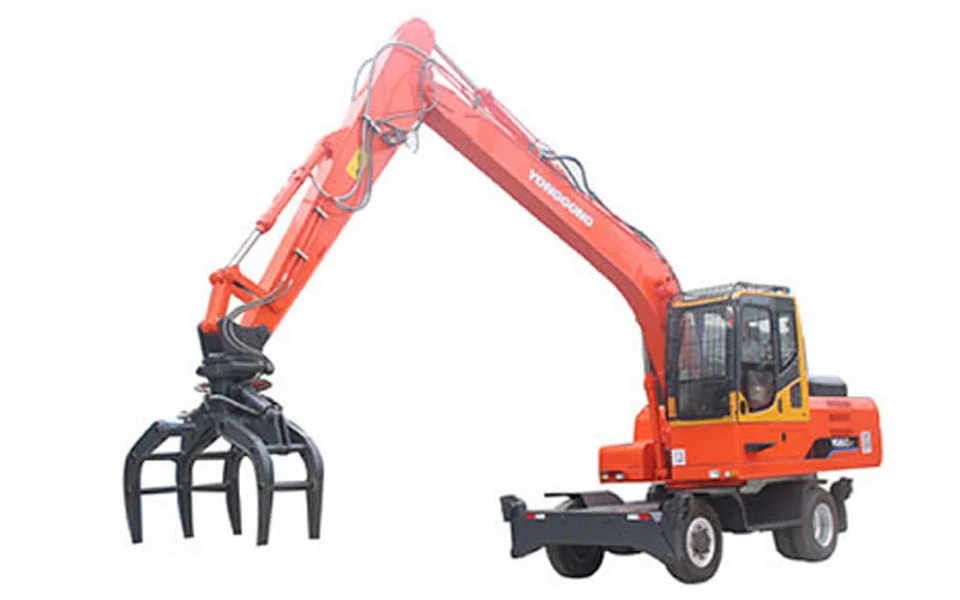 Log Grapple Operation in the Rainy Season: Common IssuesOperating in the rainy season
Before starting work, carefully assess the surroundings and check the site for soft ground or other hazards. A common method is to push a bamboo pole into the ground by hand: if it goes down easily at several points and meets no resistance within the first meter, the whole area is muddy. Log grapples often sink in such mud, making normal work impossible.
Before working in mountainous areas during the rainy season, inspect the work area for landslides, collapses or slope failures. Look for signs such as damaged slopes, improper foundation excavation, poorly disposed soil or slag, dense vegetation and muddy water running off the hillside.
If the machine starts to sink during operation, stop work immediately. Use the arm to find a firm support point and prevent further sinking, then withdraw the machine backward the same way, without moving in any other direction.
Stay alert when working in the rain. On night shifts, make sure all lights on the machine (front and rear lights, work lights, headlights and instrument lights) and the windshield wipers work properly.
After work, always park the machine on high ground away from residential areas. Avoid hazardous places such as slopes prone to collapse and riverbanks. Leave enough space for refueling, and make sure the machine can be started and moved out immediately.
Storage in the rainy season
If possible, store the machine in a dry indoor location and clean off all dirt thoroughly.
When parking outdoors, make sure the diesel tank cap and the hydraulic oil filter cover are securely closed to keep sediment out of the tanks.
Inspect the machine, repair worn parts and fit new components as needed.
Clean the main air filter element and all lubrication points. Retract all hydraulic cylinders; if that is not possible, grease the exposed cylinder rods. Then rest the tracks on long, flat protective blocks.
Once the battery is fully charged, remove it and store it in a dry place. If it is not removed, turn off the power switch or disconnect the negative battery cable.
Check the seal ring on the engine oil dipstick for wear, which could let sediment into the engine oil. Also check the fuel filler; when parking outdoors, cover it with a protective bag if necessary.
Related machines and resources
Log Grapple
YGLZ420 Wheeled Diesel Material Handler
YGSLZ500 Wheeled Dual-Power Material Handler
Wood processing
Projects by country and model
Not sure which machine fits? Compare models in the selection guide or send your working conditions for a selection plan.Read more
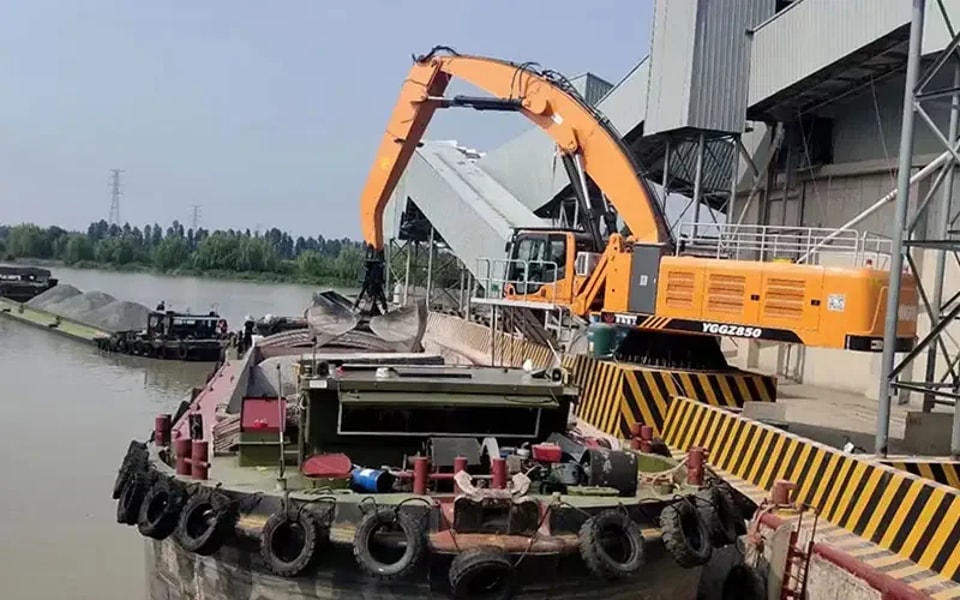 Troubleshooting Methods for Grapple MachinesGrapple machines are built from welded steel structures, which gives them stable performance and a long service life, and they are widely used in industrial and mining applications. The following troubleshooting methods cover some of the most common faults.
If the hydraulic shear does not retract after reaching the cutting position, first check the proximity switch, then check the coil.
Repeated cutting failures may be caused by a faulty transfer switch.
Frequent operation can burn out the contacts of the three central relays, which is also a major cause of malfunctions.
The entire control circuit runs on 220 V AC, and the proximity switch location is a high-failure point.
The on-site environment can also affect performance, for example by causing connection failures between the backup control box and the operating control box.
Related machines and resources
YGSZ600 Crawler Dual-Power Material Handler
YGLZ600 Wheeled Diesel Material Handler
YGGZ420 Stationary Electric Material Handler
Service, parts and training
Projects by country and model
Not sure which machine fits? Compare models in the selection guide or send your working conditions for a selection plan.Read more
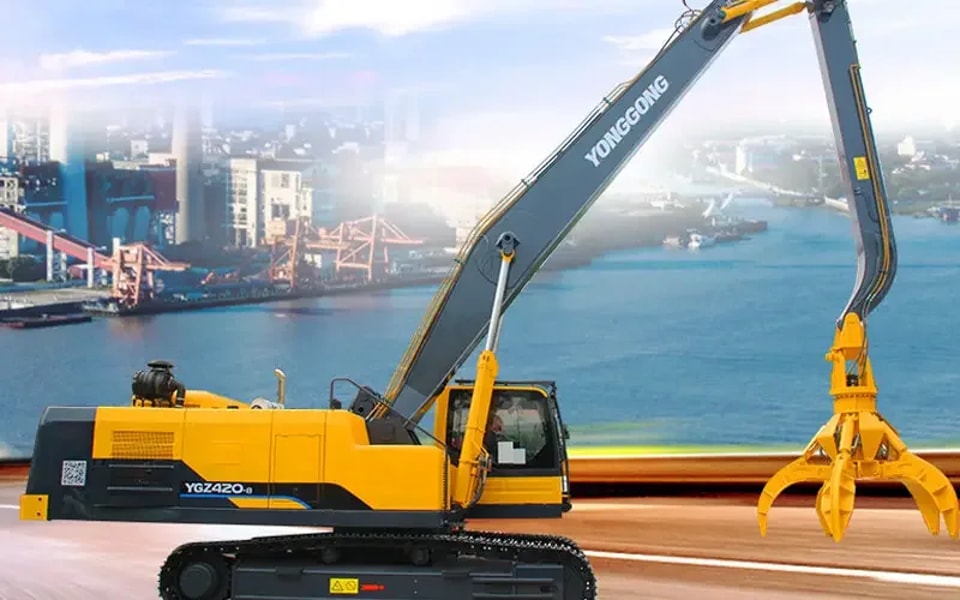 How Does a Steel Grabber Work?A steel grabber is a machine designed for gripping steel materials and is typically derived from a hydraulic excavator. Its front arm, often called the grabber arm, is usually longer. At its end is the grapple, also known as an orange-peel grapple, petal grapple or lotus grapple. Its main job is grabbing and loading materials such as scrap metal, industrial waste, crushed stone, construction debris and municipal solid waste.
How the orange-peel grapple works
The orange-peel grapple is an effective tool for handling large, irregular materials such as scrap steel, pig iron, ore and waste.
Together with fixed hinges, hydraulic cylinders and hydraulic hoses, the grapple forms a complete hydraulic control circuit, and the operator opens and closes it with a control handle. It can move mining ore, stone, timber, scrap metal and large heavy objects, extending what a standard single-purpose bucket can do.
Converting an excavator
A low-cost conversion gives an excavator heavy-handling capability and expands its range of work. When the grapple is used together with a bucket, the two can be controlled independently, giving the operator more flexibility. During digging, the grapple can be folded away so that it does not interfere, and its gripping function is used only when needed.
Configurations
Four-tine and five-tine versions.
Rotating and non-rotating versions; mounting can be fixed or swivel.
Non-rotating grapples use the excavator's bucket cylinder lines, so no additional valve block or piping is needed.
Rotating grapples require a separate valve block and piping for control.
Fully opened, a five-tine (or four-tine) grapple reaches a maximum diameter of 2 meters. Operation is simple, efficient, safe and reliable under real working conditions.
Related machines and resources
Orange Peel Grab
YGSZ520 Crawler Dual-Power Material Handler
YGGZ420 Stationary Electric Material Handler
Scrap recycling
Projects by country and model
Not sure which machine fits? Compare models in the selection guide or send your working conditions for a selection plan.Read more
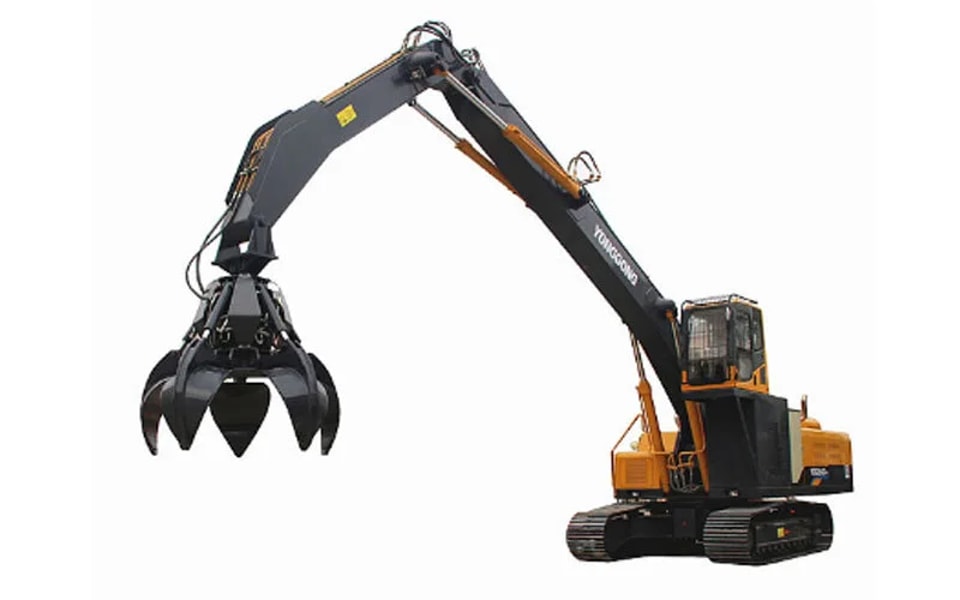 Maintenance and Care Guidelines for Grapple MachinesThe reliability and service life of a grapple machine depend not only on its manufacturing quality but also on correct operation, maintenance and care by the user.
1. Diesel engine
Operate, maintain and service the diesel engine strictly according to the engine's operation and maintenance manual.
2. Key inspection and maintenance points
Regular inspection and timely maintenance are essential for productivity and a long service life. Observe the following points.
Before inspection or maintenance, park the machine on level ground, lower the working equipment and shut off the diesel engine.
Engage the pilot safety lock (disconnecting the pilot circuit) before starting maintenance.
Hydraulic oil is hot after operation. Do not disassemble components directly when checking levels or seals, refilling or draining. First shut off the engine and relieve the system pressure by operating the pilot control lever. Avoid touching oil lines to prevent burns.
The safety valve and overload valves of the hydraulic system are set at the factory and must not be adjusted arbitrarily, to prevent accidents.
Avoid maintenance on slopes, as the machine may move or slew under its own weight.
When installing or removing hydraulic components, keep dust and debris out of the hydraulic system. Do not damage the connection surfaces; repair any damage to restore their original precision.
Clean all fittings thoroughly before installation. Do not damage or leave out sealing rings, and install hoses without kinks.
Bolts on hydraulic and connecting pipes can loosen through impact and vibration. Inspect them regularly and tighten any loose bolts promptly.
3. Storage
Under suitable climatic conditions and with the measures above, the grapple machine can be stored for up to one year. After six months of storage, run all functions for 15 minutes without load and lubricate all components.
Related machines and resources
YGSZ600 Crawler Dual-Power Material Handler
YGLZ600 Wheeled Diesel Material Handler
YGGZ600 Stationary Electric Material Handler
Service, parts and training
Projects by country and model
Not sure which machine fits? Compare models in the selection guide or send your working conditions for a selection plan.Read more How to Improve the Efficiency of Excavator-Based Scrap GrapplesAs construction projects diversify, many kinds of specialized machinery have emerged. The excavator grapple machine evolved from the standard excavator to suit specific working conditions. A steel grab attachment is a scrap handling device that performs multiple functions through interchangeable grapples and working tools, which is why it is also called a material grabber. It can quickly load and unload materials such as scrap steel, iron blocks, ore, iron powder, coal and coke, and it is widely used in steelworks scrap yards, smelting plants, ports and docks, and scrap transfer centers.
Measures to improve efficiency
Pre-operation preparation. Before operating the scrap grapple, inspect all components to make sure the machine is completely assembled and every part is installed according to specifications, to prevent avoidable malfunctions.
Correct operation. Use the machine according to the correct methods and the project specifications, and never operate it beyond its intended scope. After a period of continuous operation, shut the machine down for maintenance to prevent wear caused by overheating.
Component replacement. Replace wear-prone parts regularly to avoid failures caused by component deterioration.
Related machines and resources
Orange Peel Grab
Sorting Grapple
YGSZ520 Crawler Dual-Power Material Handler
Scrap recycling
Projects by country and model
Not sure which machine fits? Compare models in the selection guide or send your working conditions for a selection plan.Read more
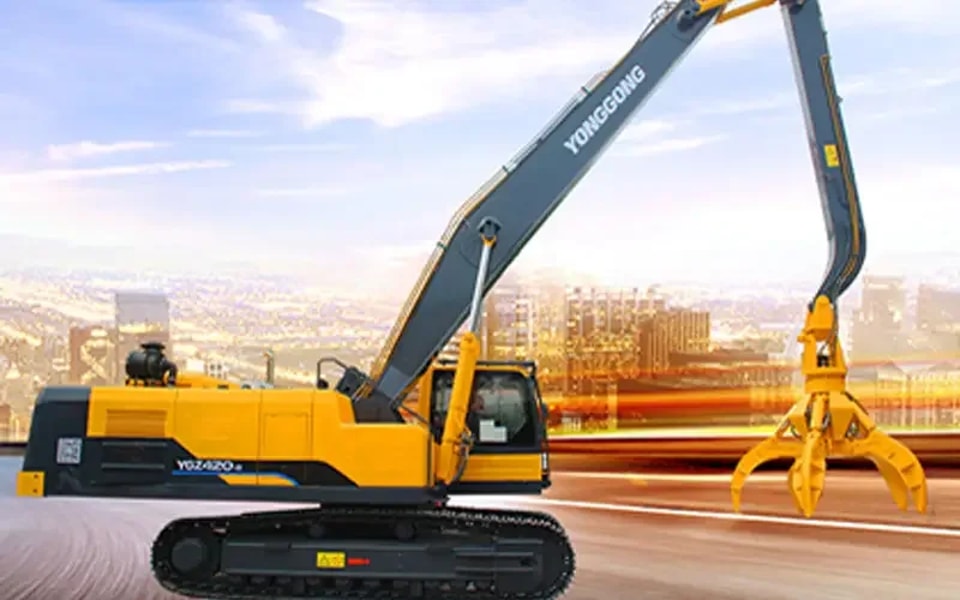 Troubleshooting Weak Gripping Force in Log GrapplesLog grapples use hydraulic drives for clamping and handling and are commonly used in mountainous regions, forestry sites and similar environments. Many log grapples are converted from excavators to meet long-term professional needs; after conversion they handle cargo more adaptably, work considerably more efficiently and operate more safely.
A machine depends on several systems working together, and a problem in any one of them can reduce overall performance. For weak gripping force, the following troubleshooting steps are recommended.
1. Check the hydraulic oil and filters
Check that the hydraulic oil level meets specifications, that the filter element is not clogged and that the oil brand meets requirements. Correct any non-compliant items first.
2. Monitor oil temperature
Monitor the oil temperature during operation. If the oil overheats, inspect the hydraulic oil cooling system to find and eliminate the cause.
3. Measure working pressure
Measure the working pressure at the weak function and compare it with the standard values.
4. Avoid hasty part replacement
Once a faulty component has been identified, do not rush to replace it. Some parts may be undamaged and reusable after cleaning; others can be repaired. Consider carefully whether replacement will actually eliminate the root cause.
5. Clean the whole system
Metal debris may have accumulated throughout the system, including the hydraulic oil tank. If it is not cleaned out, it can cause repeated damage. Before replacing components, thoroughly clean the hydraulic system and oil tank, and replace both the hydraulic oil and the filter elements.
Related machines and resources
Log Grapple
Rotating Grapple
YGLZ420 Wheeled Diesel Material Handler
Wood processing
Projects by country and model
Not sure which machine fits? Compare models in the selection guide or send your working conditions for a selection plan.Read more
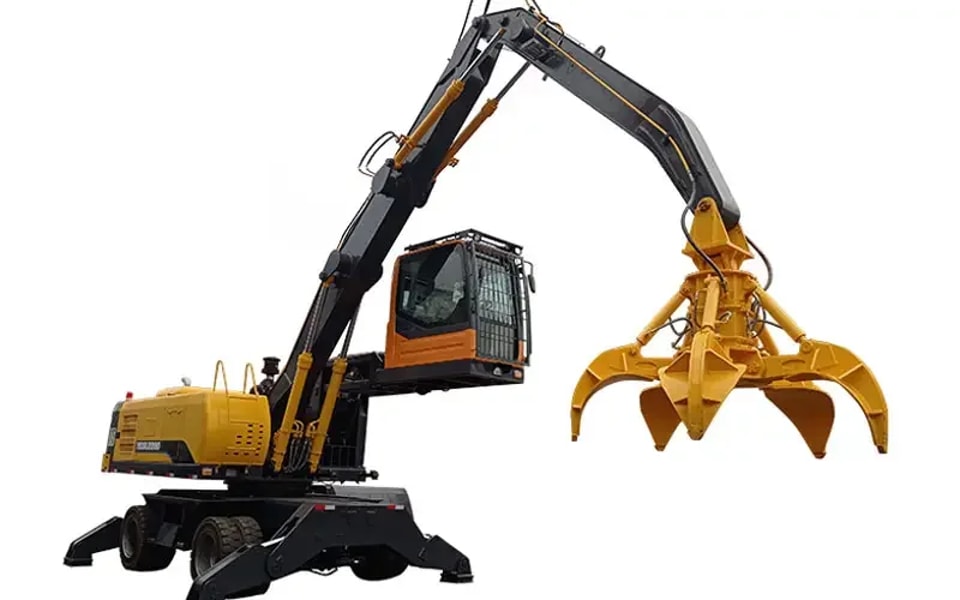 Common Rust Prevention Methods for Dock Crane BearingsBearings are critical components in dock cranes and other construction machinery. Their condition directly affects operating efficiency, service life and even safety. Besides wear, corrosion is a major challenge, so preventing bearing rust requires consistent attention and the right rust prevention measures.
Surface cleaning: choose the cleaning method according to the nature of the surface and the conditions at hand.
Surface drying: after thorough cleaning, dry the surfaces with filtered, dry compressed air.
Immersion: small parts can be immersed in rust-preventive grease so that a protective layer adheres to the surface.
Brushing: when applying by brush, avoid excessive buildup and make sure coverage is complete, with no missed areas.
Spraying: suitable for solvent-diluted or thin-film rust-preventive oils, but requires thorough fire prevention and personal protection measures.
Whichever method is used, choose the most suitable approach for the specific situation. Once the conditions needed for rust to form are eliminated, rust prevention is no longer a challenge.
Related machines and resources
YG3600-GM Rail-Mounted Folding-Jib Material Handler
YGZ2600 Rail-Mounted Electric Material Handler
YGGZ850 Stationary Electric Material Handler
Ports & bulk terminals
Projects by country and model
Not sure which machine fits? Compare models in the selection guide or send your working conditions for a selection plan.Read more
Get a selection plan
Tell us about your material, site and output. Our engineers will recommend a machine type, configuration and grab, then send a quotation.
- Share your working conditionsMaterial, throughput, site and power supply
- Receive a recommended configurationChassis, power, reach and grab matched to the job
- Get a quotationBased on the configuration agreed with you
WhatsApp · Mr. Xu Fuyuan+86 184 3829 6999
 YONGGONG
Henan Huanghai Heavy Equipment Manufacturing Co., Ltd. — rail-mounted, crawler, wheeled and stationary material handlers since 1992.
Get a selection plan
Tell us about your material, site and output. Our engineers will recommend a machine type, configuration and grab, then send a quotation.
Prefer to talk? WhatsApp +86 184 3829 6999 or henanyonggong@163.com